Day One
Reads the group. Guides the newcomer. Drafts the first message.
- ROLE
- Research · UX
UI · Prototyping - TIMELINE
- 14 weeks
- TOOLS
- Figma · design
Claude · synthesis
Perplexity · research
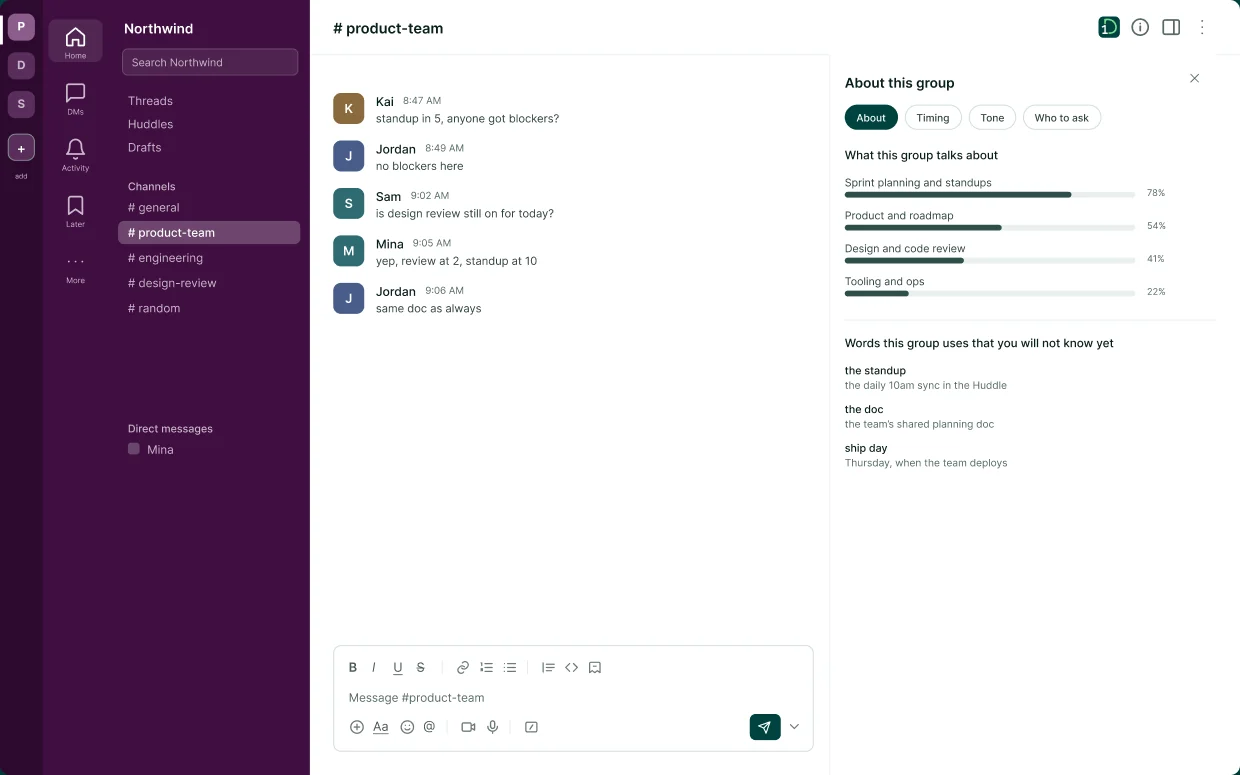
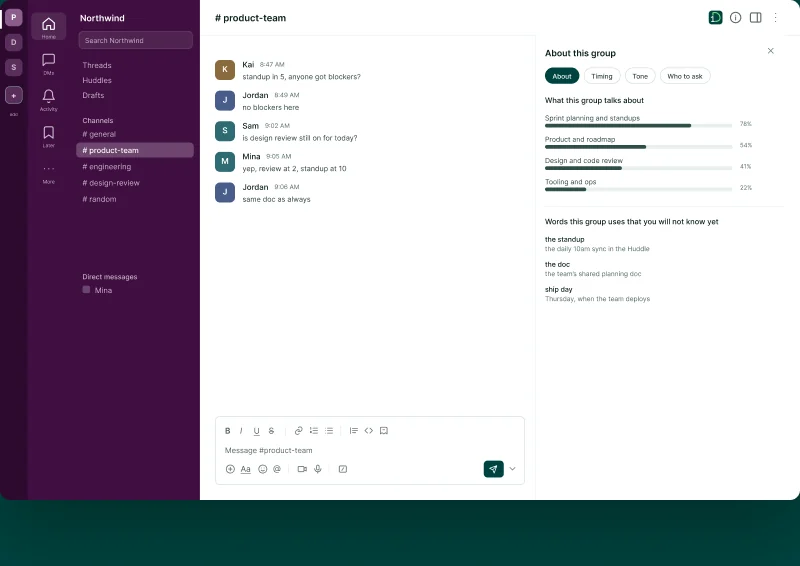
A LOOK AT WHAT WE BUILT
01THE PROBLEM
The hardest part of joining isn’t the work. It’s not knowing the unspoken rules, and being afraid to ask.
They don’t know the norms. When to post, how formal to be, whether a question is welcome. So they stay silent and read for weeks. The barrier isn’t skill. It’s the risk of getting it wrong in front of everyone.
She lent me an eraser once when I’d forgotten mine, and we became friends. Early on it made me feel safe, knowing I wasn’t the only one in that situation.
And it is measurable across onboarding, peer support, and repeated exposure.
12%
of employees strongly agree their organization onboarded them well.
Gallup · via StrongDM
29%
drop in anxiety symptoms within 90 days when newcomers had peer support.
Peer-support study · PMC (NIH)
208
experiments confirm repeated exposure reliably builds confidence in unfamiliar settings.
Meta-analysis · 208 experiments
02THE SOLUTION
The group already explains itself. Day One just reads it back.
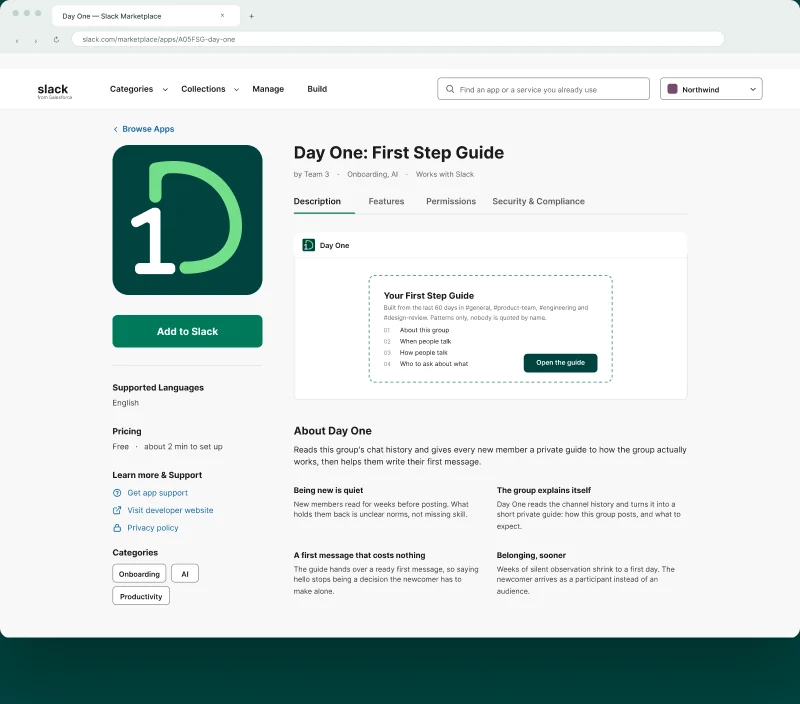
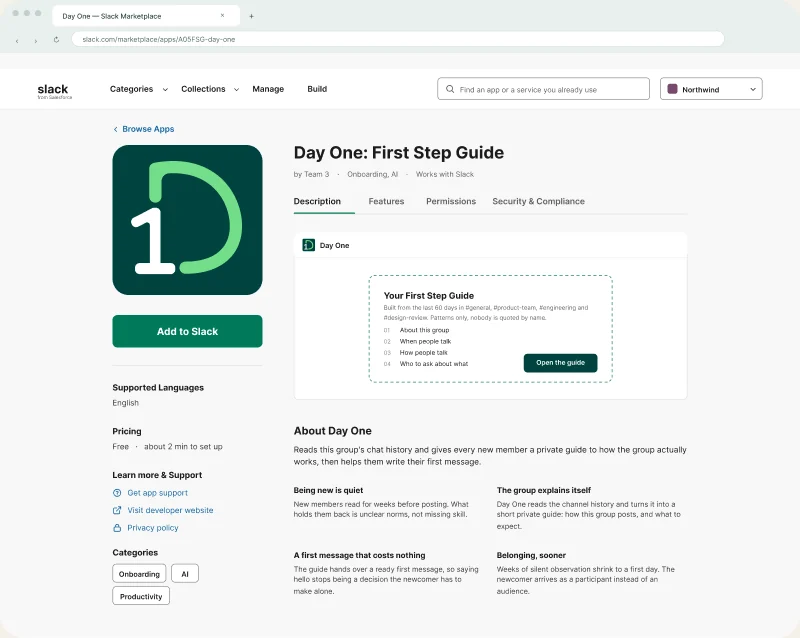
It reads the group’s own chat history and turns it into a short, private guide, then helps write a first message that fits.
Reads the history
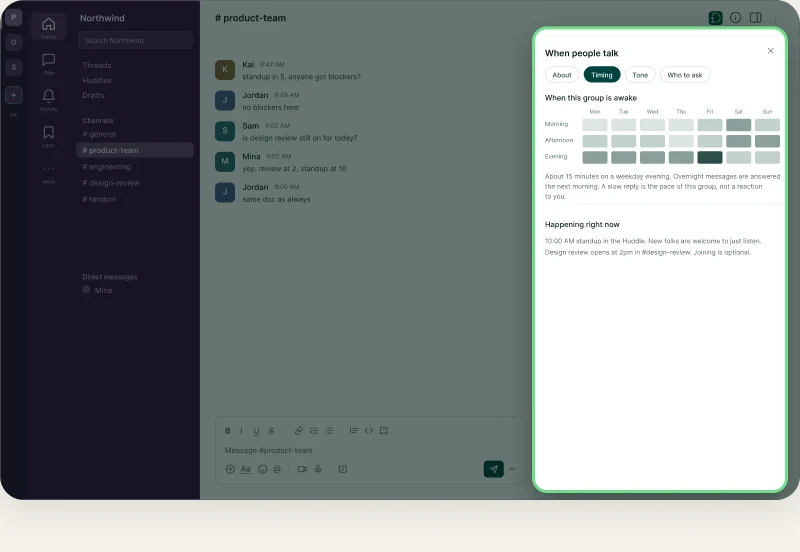
Last 60 days, channels the host allows. Patterns only, nobody quoted by name.
Builds a private guide
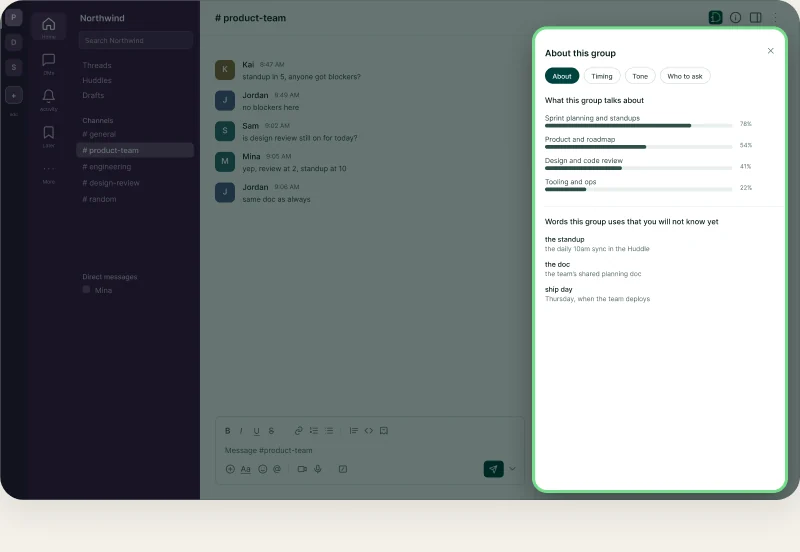
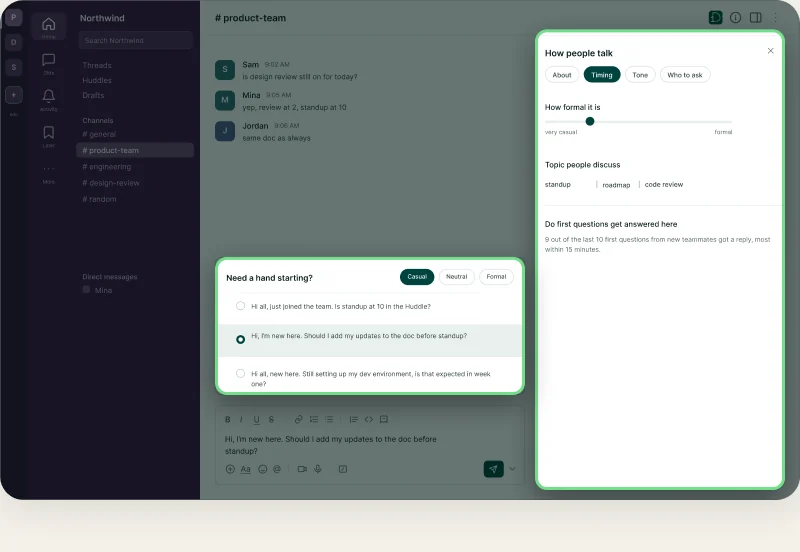
Each newcomer’s own view: what the group talks about, when people post, who to ask.
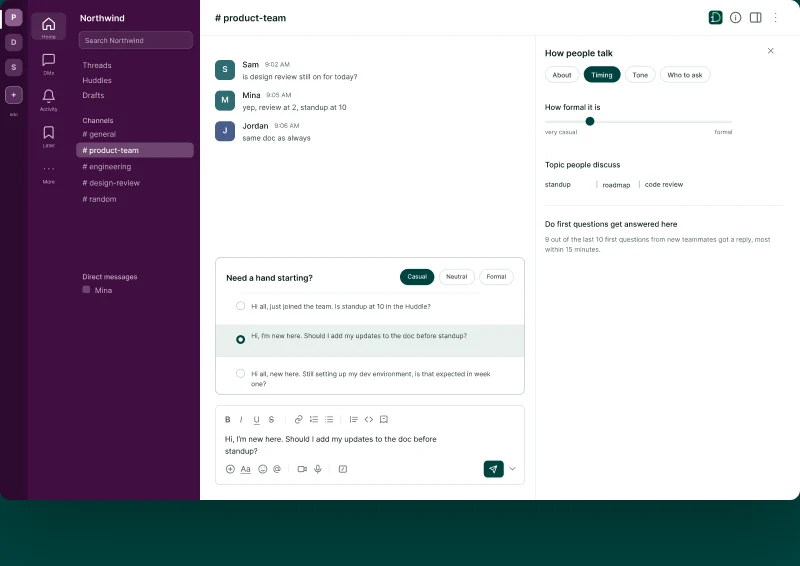
Drafts the first message
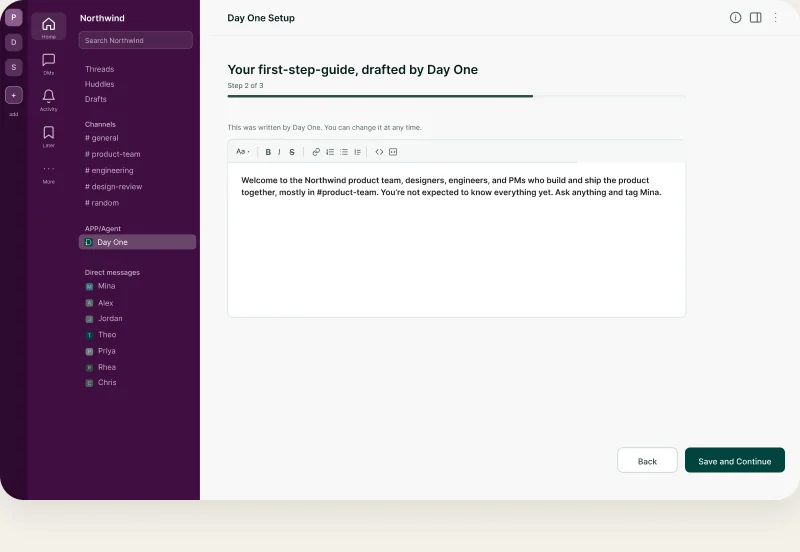
An editable opener, so saying hello isn’t a decision made alone.
HOST · ONCE
Sets it up in ~2 minutes
Picks channels, edits the auto-drafted welcome, sets who counts as new. Then never touches it again.
every newcomer
NEWCOMER · EVERY TIME
Gets a private guide, automatically
The moment they join: their own read-only guide and message help. Private, so nobody sees what they read.
03HOW WE GOT THERE · RESEARCH
We started wide: who feels new, and why?
Before building anything, we interviewed very different kinds of “new”: new hires, movers, career-switchers, looking for the pattern underneath.
Qualitative interviews
Across relocation, new jobs, career switches, and new personal practices.
4 participant types
From “new to a community” to “an insider who feels new,” mapped to compare.
Affinity mapping
Clustered every quote into themes, then pulled the recurring tensions out.
Affinity maps: clustering interview quotes into themes
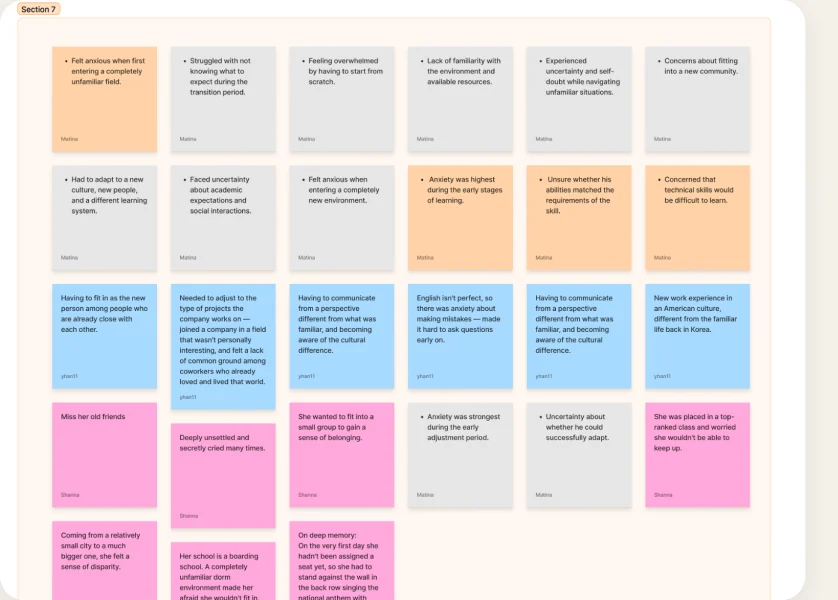
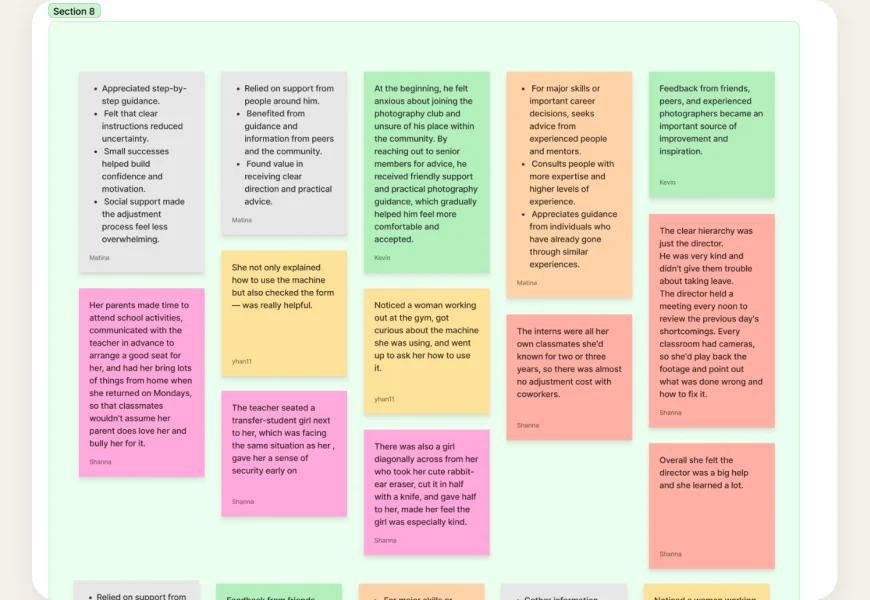
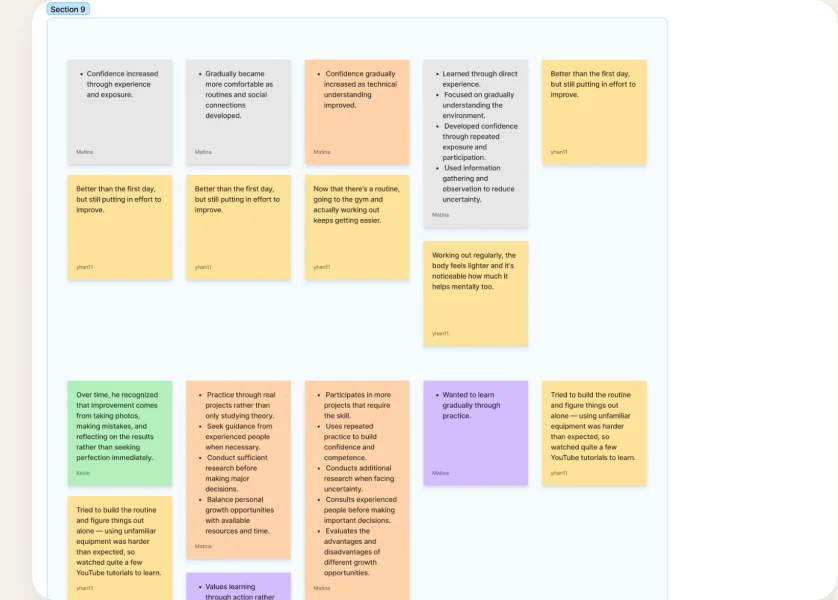
Six themes surfaced. Read together, they pointed one direction:
04THE PIVOT
Halfway through, the research told us we were solving the wrong problem.
Our first instinct was loneliness. But the “Silent Researcher” persona showed the real barrier. It wasn’t being alone. It was not knowing how the group works, and being afraid to reveal it.
How might we help a newcomer quickly find someone in the same situation, so they feel “I’m not the only one”?
How might we give a newcomer early, low-risk guidance into a group’s unspoken norms, so they feel “I know how this works”?
That shift changed the product itself, not just the words on a slide:
THE NAME
First Step GuideDay One
“First Step Guide” described a feature. “Day One” names the feeling: the first day, made survivable.
THE STRUCTURE
New channelRead-only panel
The early version made a public channel in everyone’s sidebar. Now: one private box, only the newcomer sees it, read-only.
05TEST BEFORE BUILDING
Before designing a single real screen, we tested the flow on paper.
We tested the flow on paper before investing in real screens. Three people, four tasks, host and newcomer. We watched for hesitation, skips, and whether they reached a first message.
PARTICIPANTS
Jack (IxD) · Seiya (Film) · Alex (Transportation)
TASKS
Download the agent · Personalize settings · Read group info · Write & send first message
METHOD
Paper prototype, run as a think-aloud walkthrough
Three frictions surfaced. Each one became a fix we carried into the real build:
- WE SAW
- People couldn’t find where to start. The agent’s entry point wasn’t obvious on first landing.
- WE CHANGED
- Made the Day One box the one mint-accented element in the sidebar, so it’s the first thing that stands out.
- WE SAW
- Setup showed too many options at once; users skipped past the summary preview.
- WE CHANGED
- Broke setup into numbered steps with a live preview of the newcomer’s view.
- WE SAW
- No path existed if a host declined to let the agent read history. The flow dead-ended.
- WE CHANGED
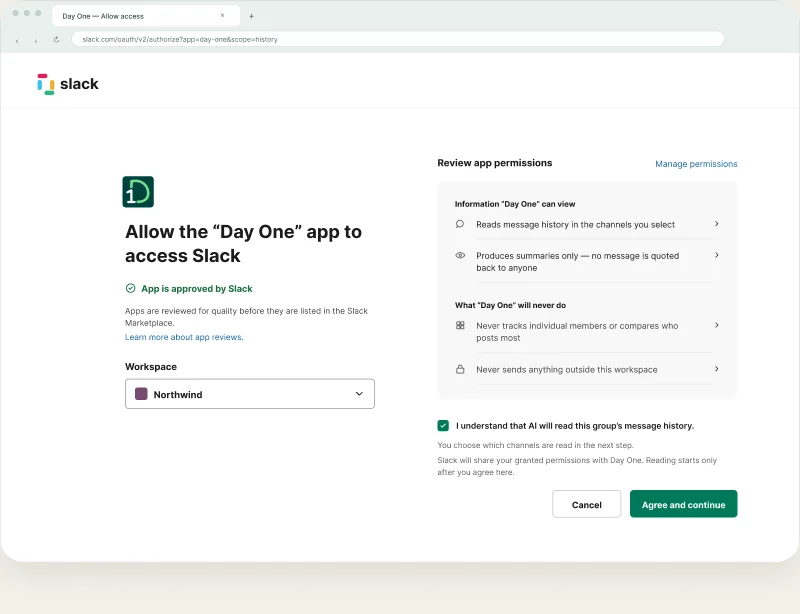
- Added a consent screen with an explicit, handled decline path.
With the flow validated, we built it for real. ↓
06THE BUILD
From validated flow to a real product.
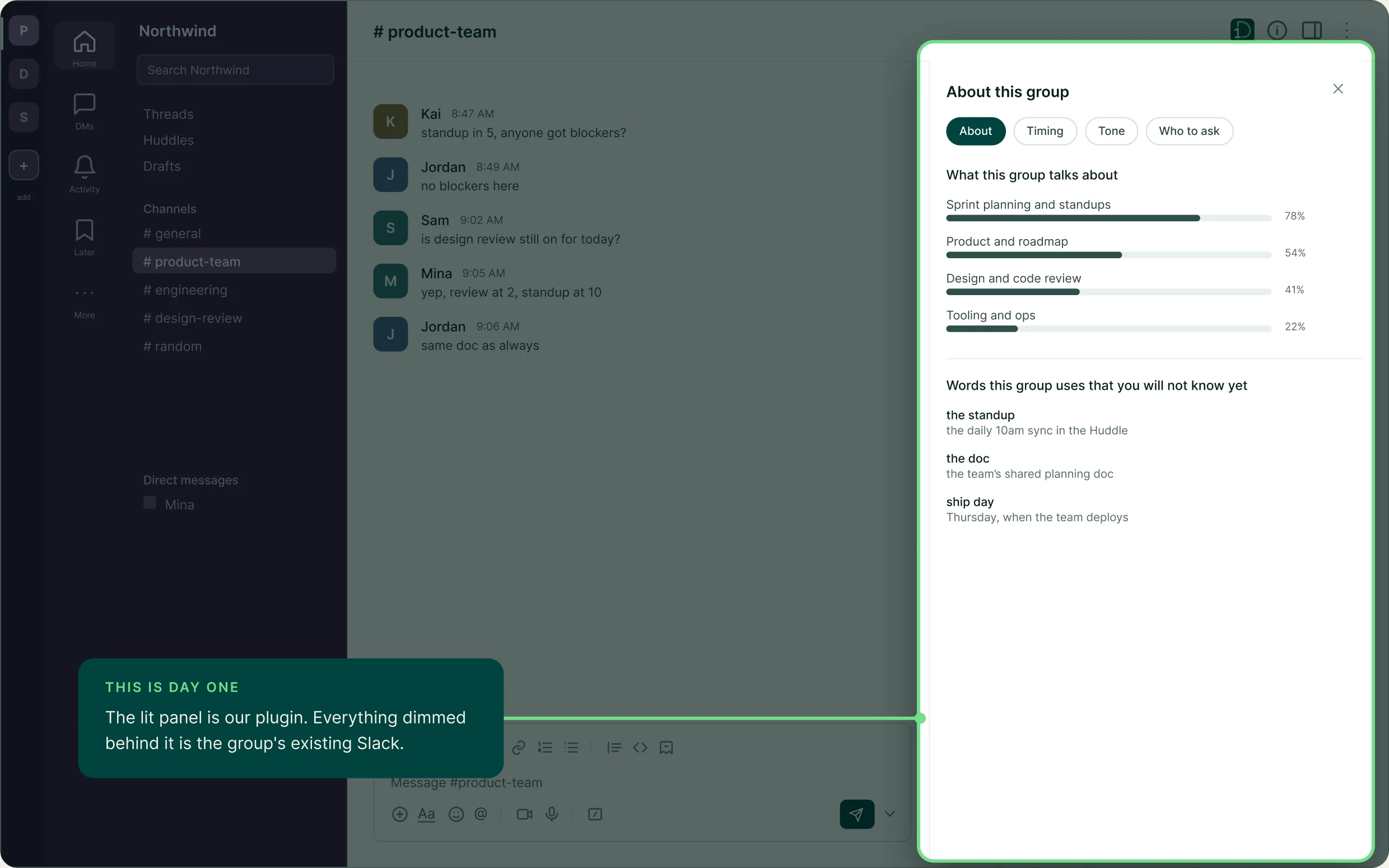
Host · sets it up once
Newcomer · the first ten minutes
07DESIGN DECISIONS
Every screen came down to one principle: lower the risk of being seen.
LANGUAGE
We never say “anxiety” in the UI
The research is about anxiety; the product isn’t. In-app copy stays functional, like “when people talk” and “who to ask,” because naming the fear on screen makes the user feel watched.
PRIVACY
Anonymous by construction
Hosts control the guide with rules, not names: a join date, a message count. Patterns only, never who posts most or who read what. Privacy is the data model, not a setting.
PRESENCE
One quiet box, never a channel
The old version added a channel to everyone’s sidebar. Now: one dashed box only the newcomer sees. Dashed borders mark every surface the app owns.
RESTRAINT
Mint appears once per screen
In Slack’s dense aubergine UI, one accent is enough. Mint marks only the Day One row, so it’s findable without competing for attention.
08REFLECTION
The best decision we made was letting the research change our mind.
We could have shipped the first idea. Instead we followed the interviews to a sharper problem, and the product got quieter, more private, more useful.
What we learned
- The barrier to belonging is information, not personality. People go quiet because they don’t know the rules, not because they’re shy.
- Framing matters twice: “anxiety” belongs in the research, but never on the screen the anxious person is reading.
- A privacy-first data model isn’t a constraint on the design. It became the reason people would trust the product at all.
Weeks of silent observation, shrunk to a first day.
SOURCES
Onboarding: Gallup, State of the Global Workplace, cited via StrongDM “Employee Onboarding Statistics.” Peer support: randomized peer-support intervention, PMC/NIH (PMC9358944). Repeated exposure: meta-analysis of 208 experiments on exposure and confidence in unfamiliar settings.